

Photoshop Tutorial: How to Edit a Portrait or Headshot Workflow
This tutorial will cover my typical post-processing workflow for a portrait or headshot using Adobe Photoshop and Bridge.

Photoshop Tutorial: Portrait Post-Processing Workflow
This tutorial will cover my typical post-processing workflow for a portrait or headshot.
Hey gang! Over the years, I’ve learned a ton of valuable information from online tutorials. Videos are more popular than ever and I watch a few each week to keep learning.
However, I started back in the days of written tutorials—’tuts’ as we called them. Perhaps I’ll make more of these (let me know in the comments), but this is #1.
For this tutorial I assume you already have a working understanding of Photoshop and Bridge. These techniques translate to other image-processing programs like Lightroom and GIMP.

NOTE: You should already be aware of adjustment layers, masks, and blending modes. This tutorial will help you perfect those techniques.
The Photo: Before and After
 |
|
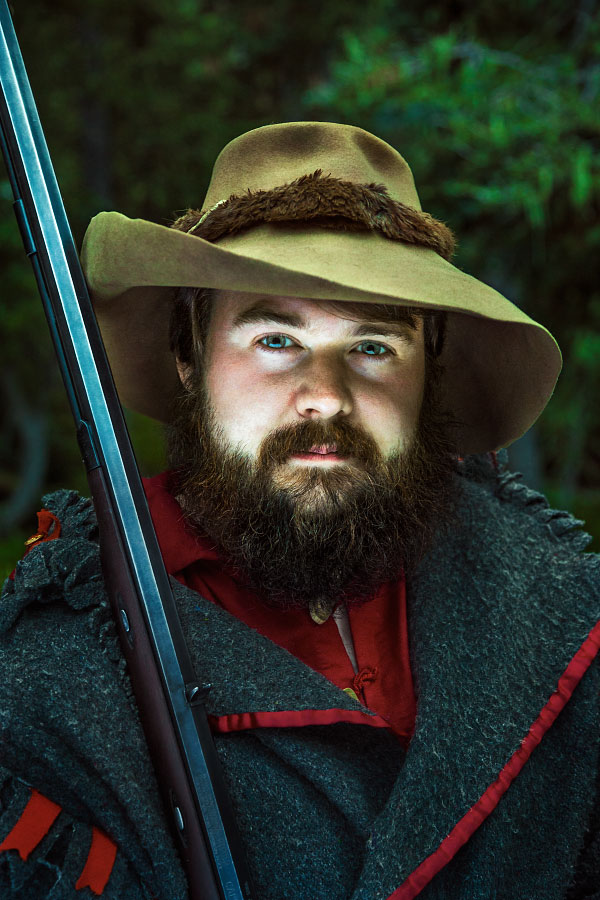
The photo I have selected is Will McKinney at Clear Creek, Philmont Scout Ranch from 2016.
This portrait is typical for me, in that:
Focal length is between 50-150mm; this is at 65mm. I prefer 100mm.
One light; the sky. And the available light is fading quickly.
Bounce-fill; which happened to be the stark backside of an Area of Responsibility map. Or if you are unfamiliar with the Ranch, a 2x3’ laminated map.
Friendly Crop variations. This image looks great at 2:3 all the way to 1:1. There’s even a good landscape option in there as well.
You can check out my portfolio for more great examples of these types of portraits.
Part I: Shooting
What made this a non-typical image was its under-exposure. It’s really, really dark.
Why?
I was forced to shoot at the far-end of the settings I normally choose. You can see my camera settings just below the histogram. I knew these settings would yield the sharpest, least-noisy results possible; something I’m always striving for.
Usually I go with a soft clam-shell light at 100mm, lighting the face around f/6.3, ISO 100 and a sync-speed which drops my background -1 or -2 stops. I use the Photek Softlighter II and it’s a dream. But that didn’t fit in my backpack on this occasion.
This was shot with natural light. It was 7:30PM, and Clear Creek is nestled in the pines. There wasn’t much I could do but work quickly.
Raw image, no adjustments, straight out of camera.
‘Basic settings’ panel in Camera Raw 9.1 with no adjustments.
REMEMBER: Camera settings are not secret formulas. You’ll find your own style and flavor after practicing.
With a good pose from Will and some great luck, I got a suitable capture. I checked the LCD and saw a sharp image and an acceptable, albeit dark, exposure (no crushed blacks or clipped highlights).
Back at the computer after an exhilarating summer,
I’m ready to begin.
Part II: Camera Raw
50% zoom level; the image is sharp and noise is manageable.
After importing and selecting the file in Bridge, I open Camera Raw Editor to apply some global post-processing edits in order to get the file ready for Photoshop.
The goals of this process, for me, are:
Good exposure. Doesn’t have to be perfect. Generally a little brighter than the intended end result.
Vibrant colors. Colors are easier to select, change, and modify if they are vibrant and well-saturated. Usually my image is too colorful after this stage.
Dodge and burn. Camera Raw Editor has great gradient and brush adjustments. I find myself making a slight vignette, even though there is a panel for that as well.
(Click images to enlarge.)
Fig. 1: Camera Raw panel settings after adjustment.

Fig.2: Adjustment brushes before and after.
Fig. 1, from left to right: in the Basic panel, you can see the exposure and shadows have been greatly increased. In the H/S/L panels, I increased the color saturation, and in most cases, darkened the luminance values. In the Camera Calibration panel, the shadows have been tinted magenta, and the blue channel has been shifted slightly.
Fig. 2: Lastly, I use the Adjustment Brush (K) for any local effects. I darkened his coat and hat and changed the white balance slightly. I brightened his face, eyes, and other deep shadows above his ears. A common technique for me is to use a -50 Clarity brush to subtract contrast from less-important details. Less contrast, less eye-pull. Check out the before and after of the adjustment brush effects above.
The processed Raw image.
NOTE: After doing this process a few times—many times—you’ll begin to understand what type of file you are ultimately striving for.
I remember wanting to copy all of the edits like I was following a strict baking recipe. It’s better to think of photo editing techniques like stove-top cooking rather than baking. David Hobby of Strobist makes the analogy like adding salt to soup: season to your taste.
After a quick coffee break, I’m pleased with the outcome and ready to move on to the next step; Photoshop.
Part III: Photoshop
Open File
Photoshop is where I take care of any pixel edits, toning, and local color/contrast adjustments. It’s easy for me to get carried away with all of the options available, but follow a typical plan-of-attack.
First, I start with an Action I made. It’s pretty basic, here’s what it gives me.
A duplicate layer (Ctrl+J). It’s a great idea to work on pixel edits on a separate layer for possibly future-recovery.
Two Curve Adjustment layers, one light curve and one dark curve, each with blend modes set to ‘luminosity’, and both placed in a group. More in Step 2.
Selective Color Adjustment layer, as well as an empty layer with a blend mode set to ‘color’ (used rarely), and placed in a group.
The file is opened and a custom action is run, leaving me with five new layers in two separate groups.
Step 1) Pixel Edits
I recall a college professor saying, “every photo needs spotting”. I always start with pixel edits. No sense in fine-tuning something if physical parts of the image are going to move around.
Generally, I remove specular hot spots. I quickly zoom in and out of the image, and anything which catches my eyes I subdue or clone-out.
Will is blessed with a great complexion; I didn’t have to do much of anything for his skin.
His hat needed work. Lots of little stains and things to catch your eyes. A mixture of Patch Tool (J) and Clone Stamp (C) on the duplicate layer are perfect for small jobs like this. There was one minor bokeh flare in the top left. This was a very easy retouching job; I wish most of my images were like this.
Check out the .gif to see the effect; it’s subtle, but noticeable on the hat and coat fringe camera-right.
NOTE: This is a great reminder why it’s a good idea to nail the shot in camera; it makes your life easy.

Step 2) Curves, Light and Dark
Dodging and burning comes from the days of film. In the digital age, I have found a solution which works for me. You’ll see variants of this technique, some which preserve colors better, but I’m partial to my own method.
A Curves layer, making an aggressive curve downwards, darkening your overall image.
A Curves layer, making an aggressive curve upwards, lightening your overall image.
Invert (Ctrl+I) both masks to black to hide their effects and set each to a blend mode of Luminosity.
Any edits on these masks affect the luminance value of the pixel while preserving the hue value.
Then comes the magic. I have a Wacom Tablet, which means I can paint my effects; it’s really fun and easy. I set myself a nice soft brush, low opacity and flow (10-20% each), and begin painting white on the black masks. White reveals, black hides.
This is what my ‘Darks 1” layer looks like.
This is what my ‘Lights 1” layer looks like. The eyes are most noticeable.
NOTE: The more aggressive your curves adjustment, the more sensitive and lightly you have to paint on the masks. 50% opacity on a brush with a steep curve like the one shown above will yield very heavy, obvious results. Build up the effect with light, low-flow brushstrokes.
Sometimes, I start zoomed out and attack big areas with a large, soft brush. Sometimes I start zoomed in with a small, hard brush and paint in fine details. It depends on the type of image. I spend double the amount of time darkening my images as I do brightening them as evidenced by photos above. Most of the time this entire step takes between 5-30 minutes.
Step 2.5) Additional Lighting Layers
If I am unsatisfied with the results from the step above, I'll add additional luminance adjustments. These are usually targeted Curve Adjustments which I paint in with my tablet.
In particular, I felt this image needed:
A masked Curve layer to darken his capote (coat), set to Luminosity blend mode.
A masked Curve layer to darken his hat.
An Exposure Adjustment, brightening the overall image. (Not shown).

This layer darkens his hat

This layer darkens his coat.

Here’s the effect of all the lighting layers.
That’s a big chunk of work. Time to move on to color toning.
Step 3) Selective Color adjustment Layer
Next, I move on to the Selective Color Adjustment. This affects the overall tone as well as individual colors.
How does it work? The ‘Colors’ flyout menu offers the user a selection of nine ranges for adjustment; six color and three luminance. Each of those is broken down into 4 sliders; Cyan, Magenta, Yellow, Black—CMYK.
Subtracting a value adds the color’s inverse (kinda). So, the inverse of Cyan, Magenta, Yelow is; Red, Green, Blue. I’ll exclude K/Black since this controls the luminance value (sorta).
Let’s look at the upper left panel, ‘Blacks’. Using the logic above, you can see that while Cyan has been subtracted, Magenta and Yellow have been been added.
Selective Color Adjustment options (Magenta not shown) and their edits.
The effects of Selective Color Adjustment.
NOTE: This will make more sense if you just play around with the sliders. Be brave. Start with ‘Neutrals’; it will be easier to see what effect the changes have on your overall image.
Take a look at the .gif above. You can see an overall shift increasing red/magenta and a decrease of cyan.
Step 3.5) Additional Color Layers
Just like step 2.5 above, if I’m not satisfied with the Selective Color Adjustment, I’ll add additional color tweaks in the forms of Hue/Saturation and Curve Adjustment layers.
I made four major adjustments:
A Hue/Saturation layer to darken and de-saturate his red shirt.
A Curve layer for the green cast on his hat.
Two layers to correct skin tone:
Hue/Saturation layer to shift the reds in his face more orange, and desaturate slightly.
Curve layer tweaking the final skin tone; less blue in the shadows, more red in the highlights.
A global Curve as a final color toning layer (before/after .gif is shown).
1. Hue/Saturation layer for the red shirt.
2. Curve layer to tweak his hat.
3. Here’s the before and after effect of both layers.

4. A Curves Adjustment adds yellow to the midtones and highlights, and adds cyan to the shadows.
The bulk of the work is done. Time for a few finishing touches.
Step 4) Final Lighting
Sometimes, I’ll add another round of ‘Darks’ and ‘Lights’, which usually contributes a subtle vignette effect. This particular image seemed to need the moodier light, so I kept going.
I added two Curve Adjustments, one to lighten and one to darken (sound familiar?), see photos below. Both layer’s blend modes are set to Normal.
A final darkening curve layer.
A final lightening curve layer.
Before and after of the final lighting layers.
We’re in the homestretch.
Step 5) Sharpening, Saving, and Exporting
After finishing my cold coffee, it’s time to save, export, and share my work. Here’s the general process I have for sharing to social media:
Image Size; 1200 pixels at 72 dpi is perfectly fine for most anything online. If I want to post to Instagram, I’ll save a version at 1080 pixels wide.
I find for downscaling, bilinear interpolation (the last menu at the bottom) works the best at preserving sharp details without looking crunchy.
Smart Sharpen; a radius of 0.4-1.1 pixels with an amount from 50-110 percent is usually what I end up choosing.
Save for Web; JPEG, with a Quality setting that gets the file below 500K. (Not shown).
This means I’ll always have the original file at it’s largest dimension in case I need to make prints or any adjustments in the future.
Image Size dialogue box.
Smart Sharpen dialogue box.
the final image:
Final edit.
And that’s my workflow for editing a portrait or headshot.
I really hope this helps some photographers and Photoshopers out there. I remember learning how all of the tools worked for a program, but not knowing how to use them to get what I wanted. Seeing other creator’s processes was vitally important in finding my own artistic style.
I hope this helps!
Thanks!
Well gang, hope you enjoyed.
If you have questions, ask in the comment section below. I promise to respond and if I get enough similar questions I’ll make another tutorial.
Let me know what you liked and please share with a friend.

Summer 100: #1-10
The drive East; it begins. From cities, to suburbs, from backwater, to nowhere, over and over again. The fully-loaded suburban hurtles down the highway at 80mph, power lines...

Summer 100: #1-10
1/100
The drive East; it begins. From cities, to suburbs, from backwater, to nowhere, over and over again. The fully-loaded suburban hurtles down the highway at 80mph, power lines racing off towards the horizon. Plans are made and futures are speculated upon. Miles tick away and beverages tip empty. And so, it begins.

2/100
A denim-ed viking sits atop his throaty, snarling beast, surveying the great desert lands. A toothy grimace falls out from his sun-worn face as he stares at me through the tempered, tinted glass. He guns the throttle, backfiring loudly, but sputters on ahead of our vehicle. Have any exceptional encounters from your car?

3/100
The vehicle pulls over for a much needed pit stop. Turning down offers for venison-jerky from the cloistered townies, I continue to wander away from the main road, looking for the abandoned shack which had caught my eye from the car. It smelled strongly of “Do Not Enter”. Ever see something from the car window that you just must explore further?

4/100
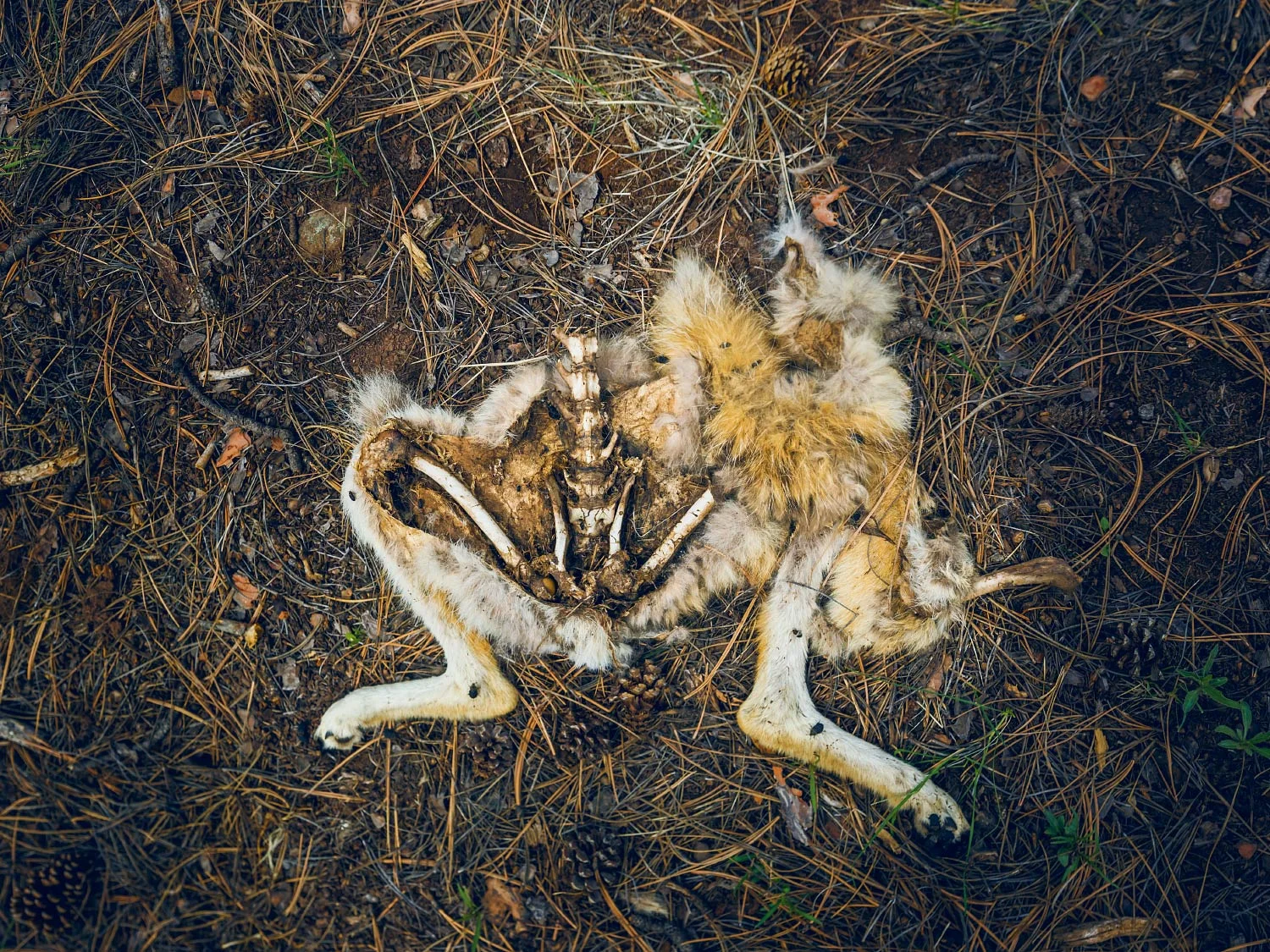
Bending down to the moistened earth, I gazed over the leathery remains. The flesh has been daintily picked away from the bone, no doubt with help from the beetles which scurried into the fur the moment my shadow crossed them. This wonderful specimen was waiting for us in the driveway at the cabin in Eagle's Nest; welcome back to the woods, kids. Ever see any cool carrion?
5/100
The rocks here, are alive. Several types of pale blue and bright orange lichen engulf the surface of the weathered stone. They share remarkable similarities to sea coral. The blood starts to pool in my ears from invertedly staring at the ground for such a time. I start to imagine the sea floor thriving with life. Fish swimming around in dense clusters, the tide swaying to and fro, the crushing pressure of the water. I stand up and the blood starts to drain from my skull; seems I still haven't acclimated yet.

6/100
The smell of fresh rain and body odor waft through the sunny streets of Taos. Quaint shops sell their tchotchkes to the thriving tourists. The town is an odd mixture of rustic Southwest and vintage urban grunge, even the barred windows have a little design flare. Sunglasses on and iced Americano in-hand, I try to disguise myself from the busking hippies and gentrified window shoppers.

7/100
The stores' diverse wares range from leather crafts and books to eco-friendly kitchen tools and precious gemstones. We wander through the narrow streets and back alleys digesting the afternoon's fare of green chile burgers and beer. There is an inaudible apprehension in the air; the crowds are days away from pouring into the quiet ski resort town. Summer has arrived.

8/100
On the way back home from Taos, we take a detour and stop by the Vietnam Veteran's Memorial Center to take a moment and sit on the benches. Thankfully, there have been a few days of intermittent precipitation, which is unusual this time of year. The dark and heavy clouds have been lingering throughout the day. Looking out upon the sweeping and vast valley, the grass appears greener. Finally, after four years of brown, a little green starts to return.

9/100
The Chase Ranch, founded in 1867 by Manly and Theresa Chase, was home for the pivotal ranching family of Cimarron, New Mexico. They raised sheep, cattle, and planted apple trees which are still growing and producing fruit to this day. Gretchen Sammis, the last living decedent of the Chase's, owned and operated the ranch for the last 58 years. In August of 2012, she passed away and the land was entrusted to Philmont. Today, during the second day of Camp Director training, we got to tour the majority of the house and grounds which had recently opened to the public. There was an eerie silence throughout the spacious but cluttered home; four generations of history under one roof left a distinct and curious smell lingering in the air. I meandered out to the courtyard and garage area, the day's teachings absorbing into me. Note to self: find cattle skulls for O'Keeffe devotionals and decorative purposes.

10/100
One of the last places at the Chase Ranch we visited for the day was the pen and barn area. The fences, which once held back hundreds upon hundreds of heads of cattle, now, are my last source of protection between one beastly bovine and my trampled demise. She incessantly mooed at the entire group until we departed. We come to learn her calf had been sold a few weeks ago – the will of the West. Someone important yells and we head back to the school bus, load up, and take off for home. The raucous bus vibrations send me into a nap-haze as our seemingly endless training schedule unfolds in my mind.


Summer 100: #31-40
Our road winds to an end and, from across the meadow, I spot a familiar quaint cabin. Nestled at the foot of the tree line in a spacious meadow, Urraca is one of 35 staffed backcountry camps on...

Summer 100: #31-40
31/100
Our road winds to an end and, from across the meadow, I spot a familiar quaint cabin. Nestled at the foot of the tree line in a spacious meadow, Urraca is one of 35 staffed backcountry camps on the Ranch, offering a challenge course and infamous evening campfire. We reach the cabin and packs are quickly dropped, boots are extracted, swings are swung, and cookies are eaten. My sweaty clothes attempt to dry while I swing back and forth. I notice their Camp Director, Jake, heading for the campfire ring, the sun beginning to set over the mesa. He epitomizes camp-staff spirit, wearing garish sweaters and responding to silly questions in equally silly voices, his positive attitude is force to be reckoned with. The show begins and I grab a seat in the front row with my back to the fire warming my still slightly damp shirt. Seems the sweater thing is practical too.

32/100
The show comes to a close and the scouts pack up and head back to their campsites, for many of these weary traveler's bedtimes have been surpassed. For the staff, however, the night is young and quiet. I grab my jacket and head over to the storage shack where the rest of the staff has started to convene out in front. Cookies and cigarettes are being passed around in some sort of ironic attempt to negate the copious clean air and constant exercise. Silently, we scan the sky, searching for shooting stars and satellites. The milky way beams down upon us; a Cheshire Cat grin. A warm glow emanates from the local town of Cimarron, we are less than three miles away from civilization. I crunch on some stale cookies and recall I was helping raise the flags earlier today. A distant memory becoming rewritten by time and miles.

33/100
The air and ground have gone cold, drugging us with slumber. Most of the staff have decided to turn in for the night, some still buzzing back and forth between the cabin and their tents, caught in bedtime ritual. The last light disappears behind a canvas flap and the three of us remaining take out our sleeping bags and make our way to the cabin to bed down for the evening. My tried and true plan of borrowing a pad has backfired due to the amount of guests; not an inch of free foam for miles. Painfully, I lay my bony waist and shoulders on the wooden floor. Suddenly, I am not sleepy anymore and I sense the other two aren't going to sleep for a while either. Beyond the tin roof, stars deftly streak by while we feverishly talk about camp politics and future positions. Running out of steam, the calm of sleep beings to wash over me and my comrades. I attempt to reflect on my first free day as I feel my eyelids droop with insurmountable weight.

34/100
I wake feeling far more refreshed than I had anticipated. The sun has just barely risen over the mesa, compelling me to start packing my gear. A quick breakfast of strawberry Pop-Tarts warmed in cowboy coffee is scarfed down before we bolt. Our goal is to make it back to basecamp before 8:15 A.M., before the select few vehicles departing into different regions of the backcountry leave the dock and are gone for the day. Boots on, we smoothly and efficiently sail down yesterday's struggle, stopping only to shed warmer outer layers. I notice a caterpillar rapidly inching through the unprotected dirt, long wiry tufts wildly sprouting all over his miniature body. I smirk and figure we are ahead of schedule for early birds. The trail starts to become wider and flatter as we press onward. We are getting close.

35/100
The four of us make it back to our parked cars in record time, still on-target to intercept the suburbans in basecamp. I make it to the dock and join up with some other recreating staffers who are planning on bumming a ride which loops through the camps in 'central country', the middle of the Ranch. I find out the driver for today's run is Stephen, one of four Backcountry Managers. He is one of my superiors and thankfully aggressively friendly. I jump at the open spare seat, knowing the ride will be nothing short of an experience. The doors slam, low gear is engaged, and we take off like Indy's Jeep, bumping, rattling, and crashing through narrow and winding dirt roads while popular 90's Disney soundtrack songs are played at eleven. I find myself sitting next to the CD of French Henry; Corey , a man with an intensity which marathons and ice hockey cannot satisfy. I poke my head and arms out of the window and enjoy the cool mountain air rushing over me. This certainly beats hiking up steep hills.

36/100
Having made all but one delivery, the nearly empty suburban crashes toward our last camp on the schedule; Crater Lake. Nestled between Fowler Mesa and Trail Peak lies this hospitable logging camp set in the early 1900's. I met up with John to see how the summer was treating him. From the cabin we survey the lake, it is nearly the fullest it has been in three years; hopefully an indication the subsiding drought. The air is cool from the altitude, the warm sun bursts through patches in the dense puffy clouds. Although our meeting is brief, his casual demeanor tells me everything is going well. I make a mental note to pass along the positive sentiment to the CD who will most likely be at the bar tonight along with everyone else. The suburban's few passengers and I climb in and continue back towards basecamp, our excursion close to ending. It's looking like I might even have some time to take a shower today.

37/100
The breaking sun hits my tent wall waking me instantly. Begrudgingly, I throw on my uniform and shuffle off towards the dining hall. I walk in, politely turning down familiar warm gruel from the kind and chipper staffers, making a beeline for the fresh fruit cart. I sit down at a table with a few people I recognize and hear them calmly talking about their plans for the day. Discussions of “a real breakfast, Taos, and The Gorge” pique my curiosity, and I inquire about any open seats. Fortunately there are a few and we plan to reconvene in just little over half an hour. I quickly bus my dishes, retreating to my tent to change into my civvies and grab my essentials. Wallet and sunglasses, jacket and camera, my pre-flight check is completed and I exit my tent once again. While en route to the parking lot, I spy a few white poppies sunning themselves. Not being a morning person, my last full free day has thankfully started off well.

38/100
Bellies full of huevos rancheros and sopapillas, we leave the greasy spoon and pile back into the minivan. Our next stop is Earthships Taos, completely sustainable and eco-friendly homes intended to minimize if not eliminate man's dependence on local utilities and fossil fuels. We pay the admittance fee and take a very short self-guided tour through the magnificent structure made for the public. Most of the science and intriguing machinery which keeps the place running is kept behind closed doors with polite “Staff Only” signs. We exit and find a few houses in various stages of being built and put on our best impressions of “politely-curious tourists” to sneak a bit closer. Rammed-earth walls dense with balding tires and aluminum cans stacked in haphazard patterns seem to be the building material of choice in most of the structures. Trash sits in neatly organized piles waiting to have its purpose recognized.

39/100
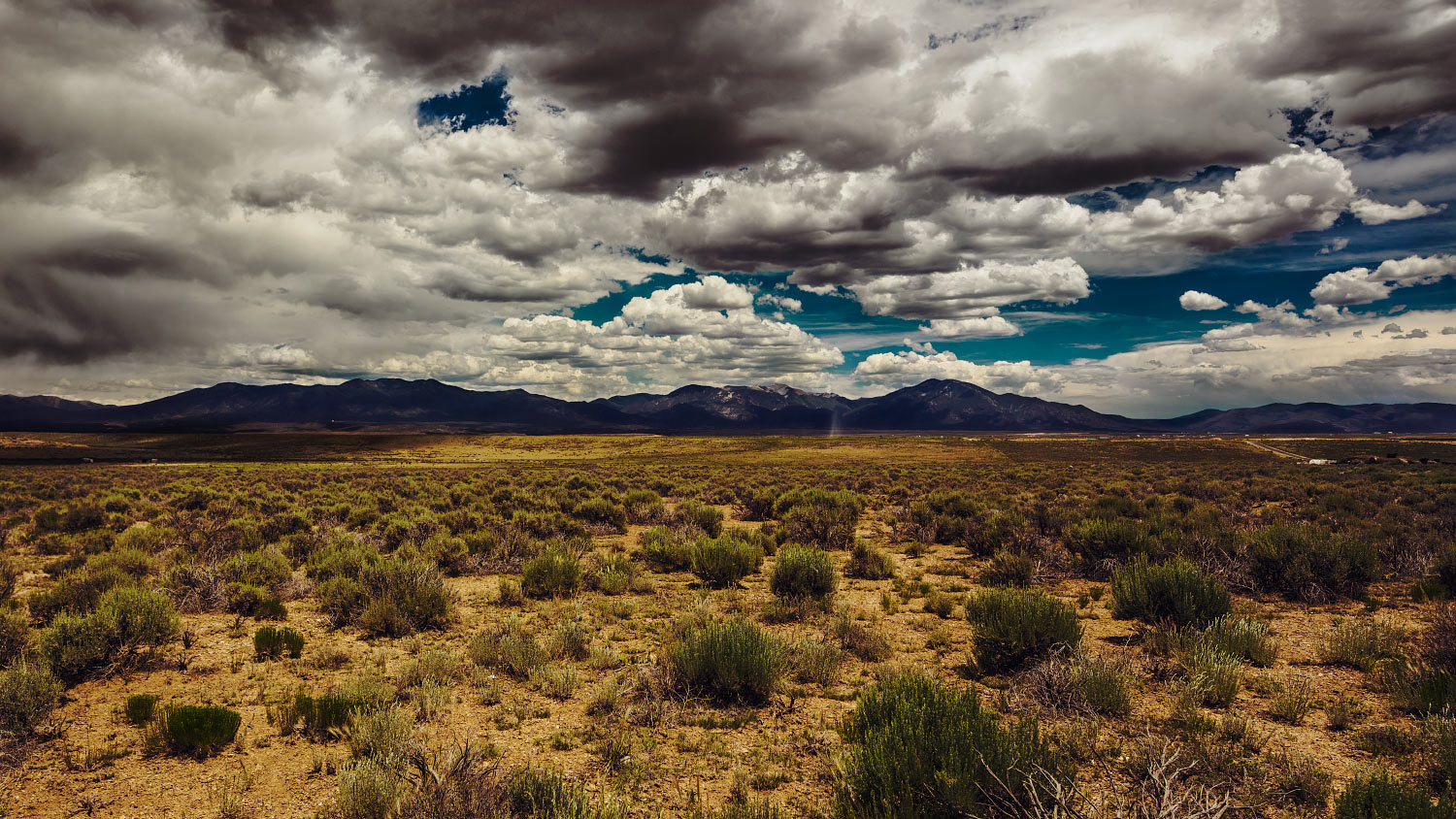
The gang continues to inspect the roof and my attention drifts to the horizon and its contours. Walking down the steep embankment of tamped dirt, I wander out past the parked cars and trash collection heaps. The western face of Wheeler Peak distantly looms while dust devils errantly spiral into a vast cloud-covered sky. Grasshoppers loudly crack and snap, drunkenly flying from one bush to another. A warm breeze flows through my damp button up, nudging me and the group back into our van. Chatter about “The Gorge” continues to build; thankfully our next stop shall put an end to my curiosity.
40/100
A massive bridge spans a gaping chasm as the sun shimmers and glints in a muddy ribbon of water far below us. I feel very silly when I realize we are at the Rio Grande Gorge Bridge. Parking the car, we venture out onto the magnificent steel and concrete arch. Suddenly, I become acutely aware at the lack of substantial railing between stable ground and dangerous void. My palms immediately begin sweating. Knowing that I am safe, I sit down, hang my head and feet between the bars and try to erase the bridge from my mind. Thousands upon thousands of years of evolution is responsible for the dryness in my mouth and the queasiness in my stomach. I remind myself of the simple fact I have never been scared of heights, but my subconscious isn't fooled. It seems my fear is rooted in the nothingness.


Summer 100: #51-60
Setting off into cool morning air, our day's journey begins as we walk down the road's narrow, furrowed lanes. I am quite familiar with this particular...

Summer 100: #51-60
51/100
Setting off into cool morning air, our day's journey begins as we walk down the road's narrow, furrowed lanes. I am quite familiar with this particular road, having hiked it many times throughout my years spent on the Ranch, but I have never witnessed it like this before. Fog is a rare treat during the summer months and I struggle to contain my excitement. Looming pines glare down upon us, their boughs and trunks disappear into gray murkiness. Dense, moist silence amplifies the babbling Rayado and crunching gravel beneath our boots. Each crest and fork holds the possibility of an entirely new landscape. I sense our destination is getting close, but in this light, how can I really be sure?

52/100
Continuing along the hazy highway, my mind drifts and quickly I find myself obsessing about tomorrow's conclave. Throughout the summer, there are two mandatory all-day meetings Camp Directors and Backcountry Managers attend, our first one is tomorrow. Undeniably I am destined for hard plastic and cold florescence. Less than thrilled, I set my sights on celebrating Independence Day the day after, surely this will keep me motivated. I trudge onward, not even having reached Phillips Junction and already I have flipped my decision on accepting a ride; yesterday's water-bottle incident continues to teach my tendons new lessons. Hydrate, or, well...

53/100
I take another swig from my Dr. Pepper and Wild Turkey, excusing myself from one of today's many barrel races; yesterday's meeting feels like a hallucination. Opting out of unsavory and crowded bathrooms, I wander past our parked cars and into the adjacent school's baseball field. Styrofoam cups and tumble weeds collect in overgrown dugouts, this dugout being no different. Hot, noon-day sun beats down upon me, occasionally interrupted for a gentle, warm breeze which floats through the rodeo grounds. Fourth of July is shaping up to be a spectacular day!

54/100
After a quick detour through the food booth, I make my way back to my uncomfortably angular bleacher seat, chili dog in hand. Pickle-flavored sunflower seeds and kettle corn flow freely while our section cheers during the ensuing cattle roping event. Yips of “c'mon now!” and loud whistles emanate from the grandstands. Evening plans are quickly and effortlessly hashed out; the annual fireworks show over Eagle Nest Lake is a crowd favorite and not to be missed. And there's always the bar on way home. Blissfully, we chat away our afternoon in shade from the awnings, occasionally glancing up at the massive blue expanse. Who needs a beach?

55/100
The vast majority of backcountry staff are busy at their respective camps, however, plenty of staff who work from basecamp have a flexible afternoon and can attend the rodeo. Next to me is Jamie, an old friend who has continuously worked in Health Lodge, now called Infirmary due to some important legislature. I remember back to 2011, she was fortunately at camp and helped administer first aid to my index finger when I stupidly sliced it wide open with my pocket knife. In 2012, we both sat front row at the very same rodeo and snapped photos of the Mutton Busting event. Last year, she visited camp frequently to shoot guns, bake cookies in our wood-burner, and transport altitude sickness cases. This year, a group of us have plans to see a show at Red Rocks, an experience which has been on my checklist for quiet some time. I look around, stories and anecdotes of people I know unfold before me like a virtual pop-up book. Standing, we applaud the rider who just took a nasty fall; Jamie looks relieved to be off-duty.

56/100
I begin to take notice of some of the locals and realize my wardrobe is woefully ill-prepared. Shiny belt buckles and alligator shoes equally compliment coordinated pearl snaps and Stetson's. Grizzled, weather-beaten cowboys sit between cheering and supportive rodeo moms; young teens can be spotted canoodling in the extremities of the bleachers while fifth and sixth graders rope and wrestle each other in front of the grandstands. The Maverick Club Rodeo has been ongoing for over 90 years and it looks as though the entire town is here to show their support.

57/100
I sink my rear into the footwell of the bleachers, back resting against the rigid metal seating; it has always felt more comfortable to sit this way. Reaching for my empty beverage after already having tested its lack of fullness several times, I realize my afternoon has blown by, similar to the clouds which we had all watched earlier. Shaking the thoughts from my mind, I close my eyes and listen to the sounds of the event. Pounding hooves and powerful whinnies can be made out over the chatting crowd and rambunctious children. And if I concentrate, even a whistling lasso or two can be heard.
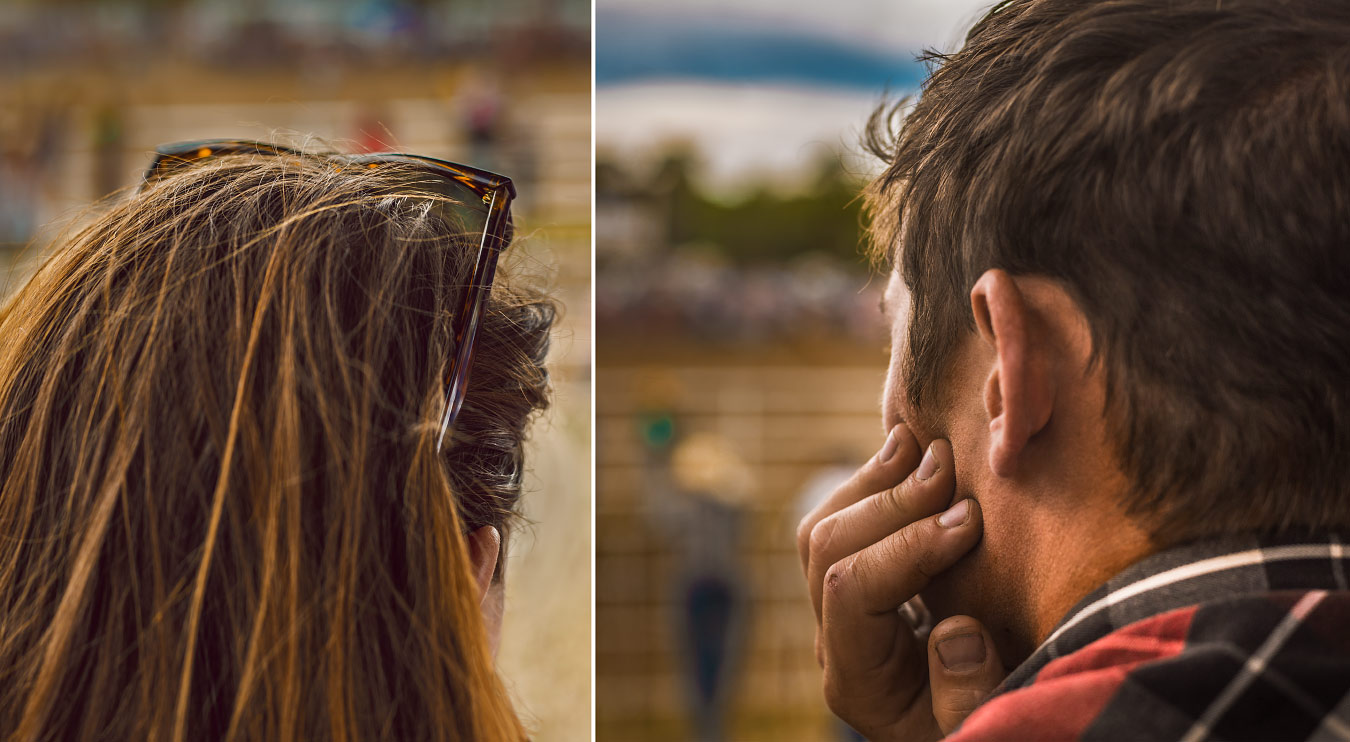
58/100
Helping to bridge the gap between Backcountry and Ranger departments are Ranger Trainers, or RT. They have numerous responsibilities, but being a Liaison for a camp is a universally agreed upon perk of the job. I have known Stuart for a few summers and this year he is our Liaison. Whether in uniform or not, high-waisted shorts and Chacos seem to be a personal requirement. Taking advantage of Zastrow's accessibility, he has visited a few times; checking in with our staff and always making a point to discuss photography and cameras.

59/100
We park our car on the shoulder of a familiar mountain road and gather our blankets and jackets during waning moments of dusk. A winding trail of car lights slowly descend into Eagle Nest; one of the few places to see a fireworks show. Munching on chips and Twizzlers, we joke and laugh the remaining light away. A solitary flash and distant bang alerts us to the show's arrival. Two years ago, I remember seeing the fireworks explode directly over the water; its receded bank a visual testament of continued drought. Bruce Springsteen crackles over a distant cell phone speaker. Conditions may change, but the ritual is still just as familiar as it ever was.

60/100
Already another week has elapsed at Zastrow. Program has been functioning smoothly, only one day of rain has soured dutch oven cobbler-cooking. Our greatly anticipated National Inspection team was here yesterday; nothing of demerit stood out which we took for success. I even managed to squeeze in a concert at Red Rocks last night to celebrate, thanks in part to my flexible staff. Camp is momentarily empty during part of our evening program and I take advantage of this brief silence to appreciate the “blood-moon”. Its radiant orange hues slowly turn to a familiar bright yellow, as if ingesting all available light while it ascends. I transport myself to last night's saga, remembering it even watched over us while we were “collapsing and screaming at the moon”.


Summer 100: #61-70
I sit down at my cluttered desk after showering by lantern; it had been a few days since my last. Paperwork, letters, camera gear, shards of...

Summer 100: #61-70
61/100
I sit down at my cluttered desk after showering by lantern; it had been a few days since my last. Paperwork, letters, camera gear, shards of information constantly migrate on its surface, always in some state of disarray. I organize it in the mornings, but by nightfall, my hard work has seemingly been negated. I invert my headlamp into my water bottle and distance myself from the oil lantern. Although each room is fully-equipped with electric lights, a blessing and a curse, I find the constant thunking of moths against florescent tubes rather irritating. Under a bluish glow, I attempt to pen a few more letters, finally finding myself starting to relax. My days off are just around the corner once again; I make a mental note to make more notes for my staff during my leave. Already, two moths have invaded and drown in my bottle; perhaps it's time to go to sleep.

62/100
Efficiently, I pack my backpack and bolt for Jimmy's car only after thanking him profusely for its use. Although driving will save me roughly 25 miles, my slapdash and incomplete plan involves a fair amount of hiking during “danger hour”; monsoon season is currently in full-swing, especially during late afternoon. I make decent time on paved highway and carefully roll through a few miles of washboard road. Cloudy skies above me don't look promising, but regardless, I park at Ponil's parking lot and start walking. Miraculously the weather holds as I arrive at Pueblano, and as if on schedule, so does the downpour, washing away any desire I had to continue onward. I decide to spend the night, fortunately I know a few of the staffers. Sam and I worked in the same vicinity last summer, our paths crossed a few times. He shows me the work which went into cleaning their once musty and dusty tie shack; it looks great.

63/100
Set in 1914, Pueblano is one of two logging camps which offers spar-pole climbing, something which I still have yet to do. Although the rain has passed and clear skies prevail, perhaps there will be better weather next time- typical New Mexico. Jacob and I catch up on how our summer's are panning out. For the last few seasons, he worked in the Ranger Department and we chat about the transition to Backcountry. Everything seems to be going well, despite mid-summer cabin-fever. Loggerball, like baseball in reverse, is just about to start; staff are infamous for having an untarnished record against campers. He tries to recruit me for their evening game, but earlier, I had strategically offered to cook dinner for camp. Definitely a spectator sport.

64/100
Beneath my head the floor rumbles, a familiar sound of clamoring boots jolts me awake. A quick glance out a dusty screened window tells me dawn on my first full day has already broken. Three...two...one...a half...counting down silently, I force myself to sit up and begin packing; my daily schedule manifests with each piece of gear stowed away. Nearly finished, I scrounge around, finding my usual provision of strawberry Pop Tarts. I venture outside to warm my bones in the sun and begin aggressively hydrating. Along the river bank, tall grass droops under the weight of morning dew. Another gorgeous day, huzzah.

65/100
My last bite of breakfast disappears as I venture towards the staff tents to begin lacing up my boots. I find Patrick doing the same, getting ready to relieve a fellow staffer from early spar-poles; today was his rotation to sleep in. My staff have asked for a similar schedule despite already having one of the latest wake-up times for a backcountry camp. The South Ponil Creek quietly hums in the background while we sip our coffee. Strapping on my pack, I stow my cup and bid the magnanimous musical men farewell before quickly cross-referencing my map. I have not taken this trail - I am not going to get stuck in the rain.

66/100
Although not steep, the trail steadily gains altitude. Up, up, up, I feel as though I should be nearing my destination. My silent prayers seemingly answered, the trail crests and before it sprawls a familiar looking meadow. Miranda's trade tent is a distant white speck, dwarfed by the foothills of Mt. Baldy. I summited the 12,441' peak in 2012 and take a moment to lean against a rock, attempting to absorb some of the grandeur. A knot of excitement forms in my stomach as I reminisce over the difficulties and stupid choices which went into climbing Baldy, or for that matter any mountain. I remember my unlikely hiking buddies and how we randomly met. I remember not bringing enough food or water I remember trying to outrun dark and ominous storm clouds while quickly plunge-stepping down loose boulders. I think would do it again. Maybe next year. Maybe.
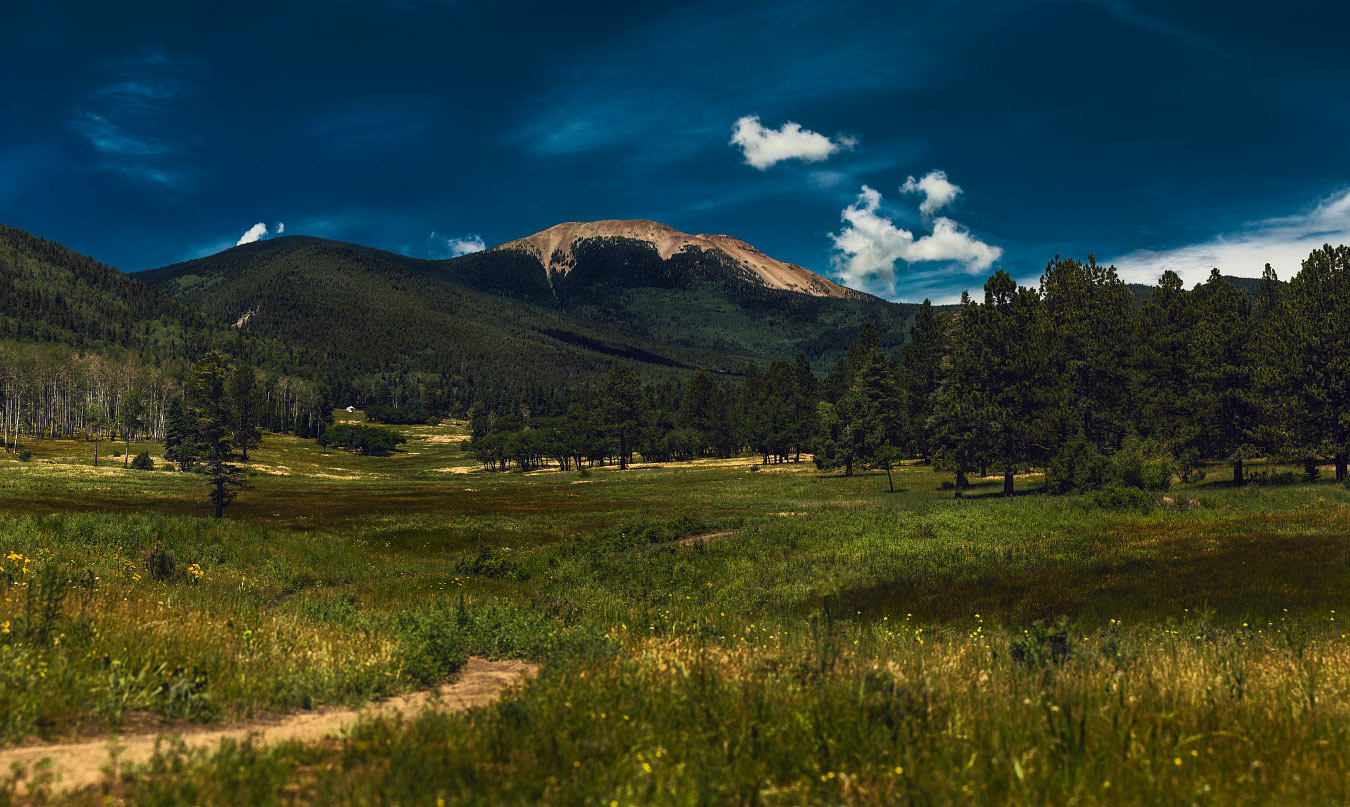
67/100
Large, puffy clouds float East high above the expansive meadow; it seems as though today's afternoon storm has passed by. A few other visiting staff and I sit and talk inside the dimly lit cabin, calmly enjoying our lack of responsibilities and current emergencies. After a hearty meal of stew and fresh baked bread, the evening's activities are ready to commence. Everyone makes their way down into the meadow as the sun begins to dip below the contour line. Three teams are efficiently split up while rules are briefly discussed. Five bases are pointed out and home rock is flipped to determine first team up to bat. When the rock drops, madness ensues; let the games begin! I may not have been able to keep all of the rules straight, but one thing remained clear from their game-ending chant: neighboring camps who request meat products better not be harboring any vegetarians.

68/100
Sunrise happens much too early at Miranda. I fumble dumbly, finding my wristwatch under a sock; the time reads 6:24. It's supposed to be my day off. I awake inside the cabin to find a few people already sweeping and convince myself to begin dressing. As I begin to pack, I remember making plans with Carter to hike today. First, I decide to investigate a large grove of aspens along their meadow while the low morning light illuminates the pale trunks. Wild flowers, large saplings, fallen trees, everything is drenched in dew, even my pants and spare pair of shoes. Up ahead, I hear him chuckling and pointing to his monstrous custom moccasins, a muzzle-loader over one shoulder. “Totally worth it”, he proclaims; a sentiment I slowly find myself agreeing with on many different levels.

69/100
The learning curve for throwing a 'hawk firmly into your target is steeper than expected and staff spend a fair amount of time sharpening the ever-dulling blades. Frequently inside the cabin, a rough scraping noise emits from rusty files being drawn across tomahawk heads. I find Nick at the dining table utilizing a spare fifteen minutes to stay ahead on maintaining program supplies. For mountain men, everything seems to be about preparation. A well-oiled gun, sharp tomahawk, sturdy shoes, each item needs to be in top shape for tracking down big game. I see a crew awaiting instruction from the porch; he doesn't hesitate in sticking his first throw.
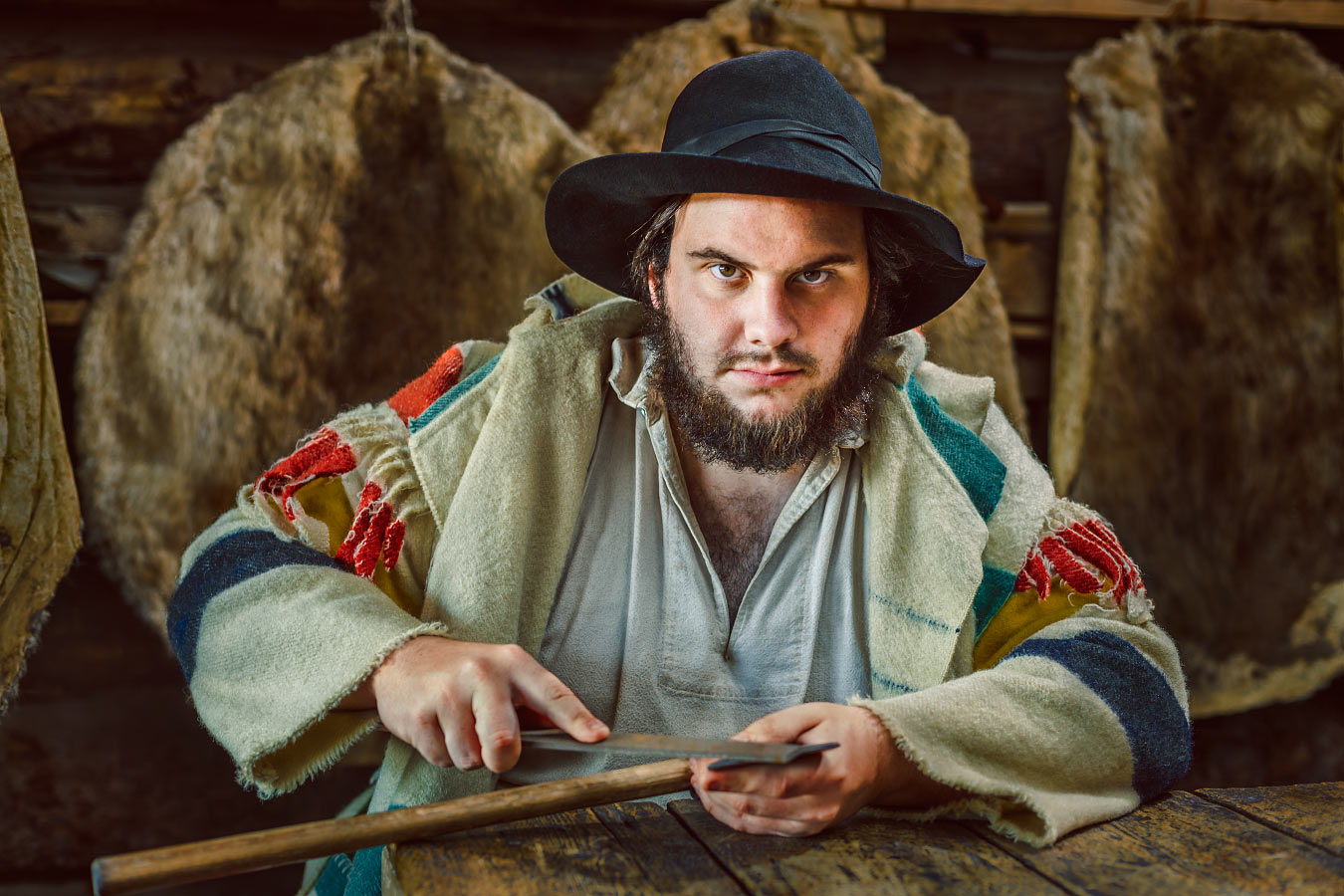
70/100
Each consecutive summer I work, I recognize fewer and fewer staff who started the same year I did. I remember the day I met Karl; it was the last week of summer and he had been transferred to our camp, helping us prepare to close down. Now, down at the end of their long and greasy table, I see him unfolding a small swatch of cloth and gesturing for me to join him. I sit down opposite of him and notice a few stacks of numberless cards, dried meat, and a rather large tomahawk. He quickly glosses over the rules; there's a twinkle in his eye. I have always known Karl to be a bit mischievous. I cautiously decide to play along.

Karl Hubbard Miranda Philmont Scout Ranch Cimarron New Mexico.
About the Blog

Justin Kernes is a photographer and writer who thrives in the great outdoors.
From 2010-2017, he worked in the backcountry at Philmont Scout Ranch in New Mexico.
In 2018 “Tiny Slice” successfully thru-hiked the Pacific Crest Trail.
Search the Blog
Featured Posts


Photos and stories from my thru-hike of the PCT. This post covers day 111, Goat Rocks and my 30th birthday.